
Working on the production of The Addict’s Wake taught me how much I don’t know about addiction. Before you judge an addict, walk this path:
When was the last time you did one of the following, despite knowing they’re not healthy?
- Overworking
- Overeating
- Doom-scrolling
- Gossiping
- Watching pornography
- Drinking alcohol
- Forcing control over others
Addiction isn’t just one category of people. Lots of people who overeat also spend too much time looking at Instagram. And lots of people who drink also gamble, watch pornography, or yell at others too much. All of these things are a spectrum of coping.
Think about a bad breakup or day at work. What did you do?
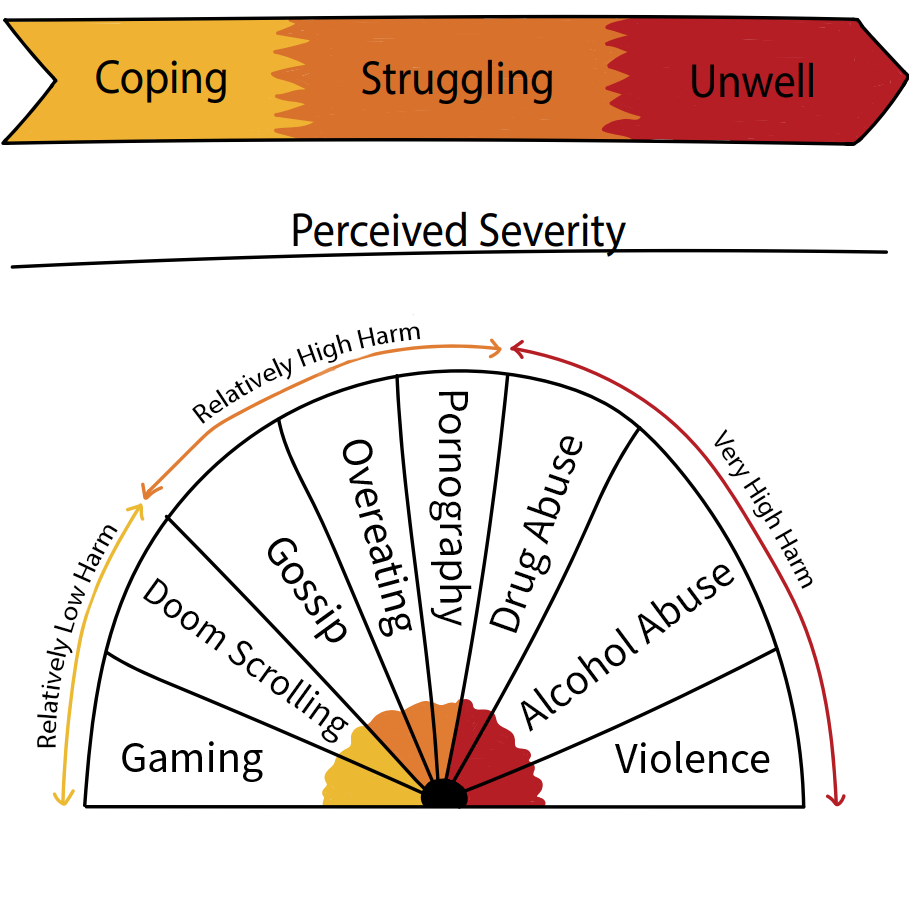
Watched TV — Played Video Games — Ate Ice Cream — Drank — Took Drugs — Became Violent
All of these behaviors and more are on a spectrum. Eating ice cream is certainly better than using cocaine. But you start to realize: who among us hasn’t sought comfort in a pint of Ben and Jerry’s after a bad day? Or a glass of wine? Or two? Or a glass of Scotch? Who among us hasn’t spent the whole weekend watching The Office for the fifth time through?
Can you start to see how a bad breakup might compound if you also faced an injury or illness that resulted in job loss and the financial stress of paying the rent at the same time?
During the filming of The Addict’s Wake we recognized no addict chooses to become an addict. Not unlike how most of us don’t really think much about “wasting” a weekend watching TV when we “know” we could be reading, gardening, or some other “productive” use of time. It just happens.
Do we care about “degrees” of addiction?
People who are addicted to something know that shame fuels relapse. Punishment just increases secrecy. Sobriety doesn’t equal healing. Addicts also know that belonging does more to help heal faster than almost anything else.
That’s why your effort to break your constant Instagram scrolling always ends up in “relapse” or secrecy, in the car when no one else is around or in a bathroom stall. It’s why having the TV in the living room ends up with us watching more TV.
You can argue that these are not the same moral equivalents. That becoming addicted to painkillers “would never happen” to you or that TV or Instagram is harmless. But I could make moral judgments that watching TV takes away time from your kids or spouse. Or endless Instagram scrolling leads to lusting over lifestyles, people, or things that act as a gateway to pornography and isolation.
So do we care? How do we grapple with moderation and “the right amount” of anything? Is five hours of TV watching a day “right” for a 15 year old home over the summer? Or a 40 year old who needs to work? Or a retiree with not much else to do?
We can’t begin to make these kinds of moral judgments about what is and isn’t right. But we also recognize we need societal boundaries and limits, either by age and law (like media restrictions for minors) or by culture (like watching TV 16 hours a day at any age is detrimental).
Churches need to be focused on the spectrum of addiction
Churches have to remain focused on this spectrum of addiction, including the ones that are easy to label and the ones easier to hide. None of this should be construed to say that a person who spends too much time watching TV or eating ice cream is an addict on “the same level” as a heroin addiction.
This isn’t news to church leaders. If we only make space for the visible and culturally misappropriate addictions we risk letting everyone struggle in silence with whatever their challenges are. A person battling alcohol dependence and the person quietly numbing out on their phone are not as far apart as we might think. Both are likely struggling with loneliness, connection, purpose, and well being, just in their own ways.
We’ve always known that sin has no gradient. Murder and lust, or lying and abusive relationships are not separate in God’s eyes. The church was never meant to be the place that sorts people into categories of “serious” or “not serious”. Church is the place where people become honest with themselves and each other.
Small addictions rarely stay small. They shape our habits, dull our minds, and slowly pull us away from connection to God, community, others, and ourselves.
Churches can’t be the place where people have to hit “rock bottom” first before we care. People everywhere are talking about the attention and distraction addiction, though usually about “kids these days”. Some of that is helpful, but there are a lot of grandparents watching TV alone all day long and middle-aged people quietly killing themselves through sugar, work, and their own screen time.
Addiction lives on a spectrum, but compassion shouldn’t. Real compassion starts when we all admit that like being sinners, we’re all “kind of an addict”, too, and we’re not all that different from each other.